
Arriving at the Lasting Library After the Scientific Journey
Every scientific journey begins with a question that opens a door to numerous paths of discovery. Regardless of what question the journey started with or which experimental paths were chosen, discoveries that involve library preparation often end with one thing: next-generation sequencing (NGS) data.
But…can the sequencing data actually be trusted?
Throughout November, researchers went on a journey with Zymo Research to learn about library preparation workflows that can be completed quickly, handle challenging inputs, and be automated. In this final blog, the destination of our journey lies just ahead. Welcome to the Lasting Library, where the challenge is no longer about generating data. Instead, the challenge is ensuring confidence that the data remains faithful to the biology.
Complex workflows can leave researchers wondering whether they’re following a true biological signal or just a technical artifact. At the Lasting Library, explore innovations designed to reduce uncertainty, preserve biology, and generate results that can be trusted long after the sequencing run is done.
How to Sequence with Confidence
This NGS November, Zymo Research is celebrating the scientists pushing the boundaries of NGS library preparation. Empowering researchers as they set out on their scientific journey, Zymo Research offered a weekly series throughout November to visit several common friction points in library preparation.
This week, the scientific journey of NGS November’s 2026 blog series is coming to an end. But that doesn’t mean that Zymo Research’s role as an ally on your scientific journey has to be over.
Zymo Research is excited to continue to support scientists, constantly innovating to develop library preparation technologies that more accurately capture biological information. After all, sequencing with confidence starts long before the actual sequencing begins. Biases introduced during the library preparation workflow itself can lead to uneven coverage, artificial sequence modifications, and workflow-dependent artifacts that quietly influence the interpretation of a biological story. Lasting discoveries require more than just data; they require confidence that the workflows generate data that faithfully reflects each sample.
Every discovery deserves a strong foundation. Achieve a Lasting Library with our last round of featured products for results that stand the scrutinizing test of time.
Reproducible Coverage for Accurate Methylation Calling
When analyzing both DNA fragmentation and methylation patterns, preserving native DNA fragment structure is critical. Conventional double-stranded DNA library preparation can introduce bias through end repair and DNA synthesis, which may incorporate artificial unmethylated cytosines not only at fragment termini but also along the DNA strand. Built on Zymo Research’s extensively validated, gentle EZ DNA Methylation-Lightning™ bisulfite conversion chemistry, the Zymo-Seq™ Trio WGBS Library Kit provides a reliable workflow for whole-genome bisulfite sequencing (WGBS) from cell-free DNA, FFPE-derived DNA, and genomic DNA with as little as 5 ng of input. By combining mild yet efficient bisulfite conversion with direct splinted-adapter ligation to single-stranded DNA, the workflow minimizes DNA degradation while enabling the recovery of nicked, damaged, and short DNA fragments that might otherwise be lost during conventional library preparation. Without conventional end repair or DNA synthesis, the workflow better preserves native fragment termini and minimizes library preparation-induced methylation bias, enabling more accurate methylation profiling across the entire DNA fragment.
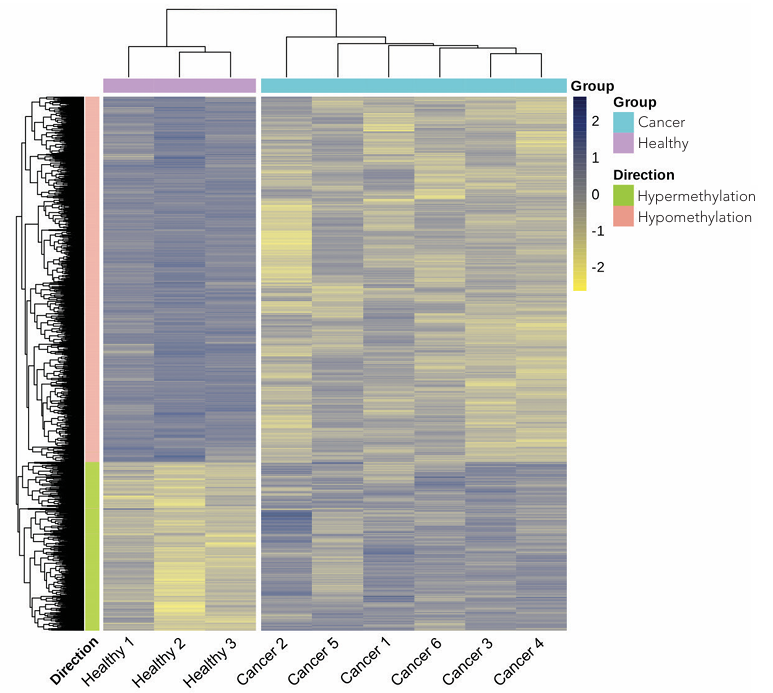
Zymo-Seq™ Trio WGBS libraries show clear distinction of CpG methylation levels between lung cancer and healthy cell-free DNA samples. Libraries were prepared from 5 ng of cell-free DNA derived from donors with lung cancer or no disease. Differentially methylated regions (DMRs) were determined by the publicly available package DSS (v2.24.0, adjusted p-value < 0.05). The direction of methylation level difference was relative to the healthy control group.
Analyze Accessible Chromatin with 7x Less Mitochondrial Contamination
Assay for Transposase Accessible Chromatin with high throughput Sequencing (ATAC-seq) identifies open chromatin regions that are instrumental for transcription factor binding and overall gene regulation. However, reads from contaminating mitochondria can obscure those from nuclei because mitochondrial DNA is not packaged into nucleosomes, leaving it entirely exposed to capture during ATAC-seq. The all-in-one Zymo-Seq ATAC Library Kit allows for high-quality library preparation that results in 7x less mitochondrial contamination compared to competing kits, opening the door for greater sequencing depth. With as little as 50,000 cells and 4 hours, the Zymo-Seq ATAC Library Kit can produce highly correlated replicates from diverse species using fresh or frozen cultured cells or tissue input. First, a gentle lysis step releases isolated nuclei while avoiding disruption of plasma membrane integrity, ensuring limited mitochondrial DNA exposure. Tagmentation then fragments accessible chromatin and inserts flanking adapters that are used for downstream library amplification. This general library preparation workflow has produced high quality, reproducible libraries from a wide variety of inputs including rainbow trout skeletal muscle tissue1, mouse embryonic stem cells2, cultured human melanoma cells3, and more. Access reproducible data from accessible chromatin while increasing sequencing depth with the Zymo-Seq ATAC Library Kit.
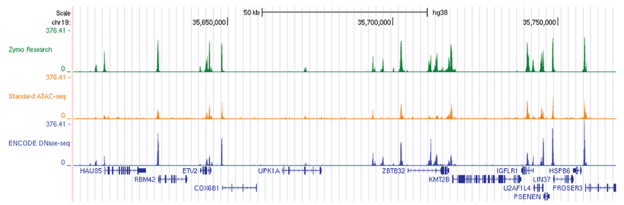
Browser tracker depicting GM12878 ATAC-seq assay using the Zymo-Seq ATAC Library Kit. Peaks overlap at the same sites identified by DNase-seq in the ENCODE project as well as the standard ATAC-seq protocol showing both quality and consistency.
More Products to Achieve a Lasting Library
Transcriptomics: Generate unbiased gene expression data for total RNA libraries from any species with the Zymo-Seq RiboFree® Total RNA Library Kit. The probe-free chemistry avoids off-target depletion effects and minimizes depletion bias to preserve true transcript abundance.
Microbiomics: Quantify absolute copy numbers of 16S rRNA through real-time PCR with the Quick-16S™ Plus kits. The kits include the ZymoBIOMICS® 16S/ITS qPCR Standard to achieve absolute quantification for microbial samples.
References:
- L. Larrondo et al., Int. J. Mol. Sci. 27, 8482 (2026). doi: 10.3390/ijms27198482
- C.R. Campbell et al., bioRxiv (2026). doi: 10.64898/2026.04.15.718829
- T. Sævarsson et al., Cell Commun. Signal. 24, 323 (2026). doi: 10.1186/s12964-026-02840-0